

If you own a privately held company, there’s something you need to know:
Your team might not be telling you the whole truth.
Not because they’re dishonest. Because they are not sure it’s safe.
Alan Mulally learned this the hard way when he took over as CEO of Ford in 2006 — the year the company lost $12.7 billion.
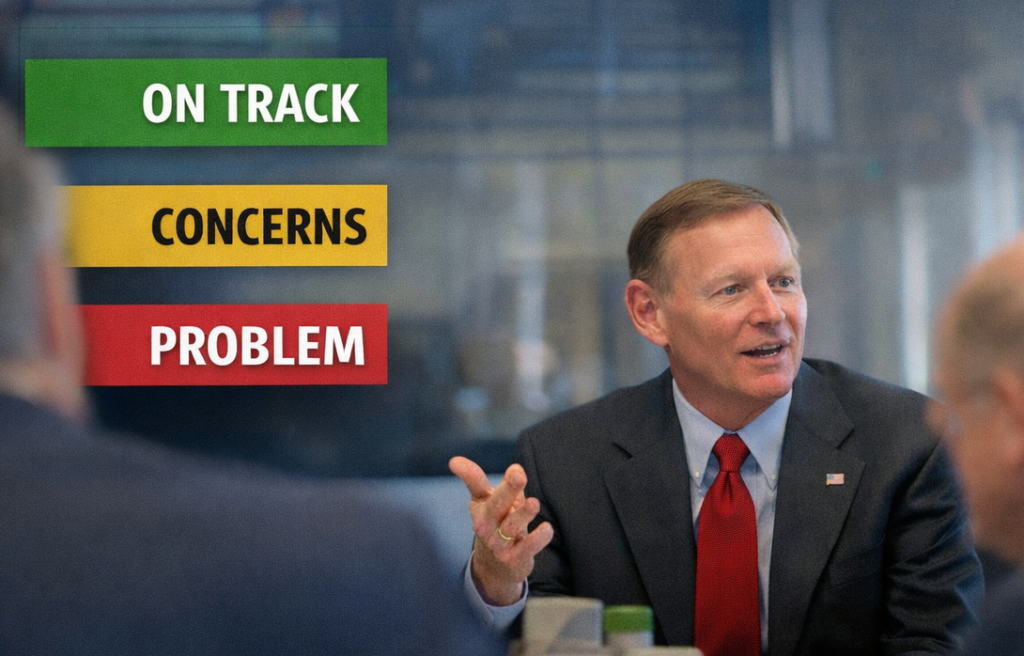
Every week, his leadership team gathered to review project status using a simple color system: Green for on track, Yellow for concerns, Red for major problems.
Week after week, every single slide was green.
$12.7 billion in losses and not a single problem on the board.
Mulally finally stopped a meeting and asked the obvious: “How can everything be green if we’re losing billions of dollars?”
No one answered.
The reporting system wasn’t broken. The culture was. For years, executives had learned that raising a red flag meant being singled out, criticized, or blamed. So they buried the problems.
Then Mark Fields, Ford’s COO at the time, broke the pattern. He walked in with a RED slide. A major vehicle launch was failing.
Everyone braced for the fallout.
Instead, Mulally clapped.
“Thank you for the transparency. Now, how can we help?”
That one response changed everything. The following week, the report was filled with yellows and reds and real solutions began to flow. As Fields later recounted in “An Insider’s View of the Ford Story” from the Ross School of Business, this moment was a turning point. Ford turned a $12.7 billion loss 📉 into $5.66 billion in profit 📈 by 2012.
The turnaround didn’t begin with a new product line. It began with honesty.
Now here’s why this matters to you as a business owner.
In a privately owned company, there are fewer layers between you and reality, but that doesn’t mean you’re getting it unfiltered. Your managers, your key employees, even your leadership team may be softening the message, avoiding conflict, or simply telling you what they think you want to hear.
In The MasterThink® Way, we call this your Internal Reality. It’s one of the first things we examine in the THINK phase. Because analyzing your people, operations, financials, and leadership honestly is the foundation for every strategic decision that follows.
You can’t FOCUS on the right priorities or EXECUTE with discipline if the information you’re working from is incomplete.
The Leadership Question
Most leaders say they want feedback.
But employees are asking a different question:
Is it safe to tell the truth here?
So here’s today’s MasterThought:
When was the last time you asked your employees for feedback and created a safe space where they felt comfortable enough to give it?
Because the fastest way to improve your company might not be another strategy meeting.
It might simply be a conversation.